Popular Posts

Showing posts with label Garden. Show all posts

Monday, February 9, 2015

Soil Information for Gardeners

I have notebooks full of information I have gleaned from different resources over the years.  I also have index cards with information I consider pretty important to remember from year to year.  I do this for different areas of our lives.  For example, I write information on recipes and nutrition information, animal keeping and feeding, herbal information, and gardening information which is what I am going to write about today.  I hope it will be of use to you all.  It has helped us to have healthier crops and I like the fact that I am adding more nutrients and sugars into the plants we grow.  Hopefully this is helping to improve the health of our animals and ourselves.  I am still learning in all these areas so know what you are reading is a work in progress for me and is not intended to be complete or authoritative but maybe just helpful........ Oh, and a lot of this information has been taken from a great book called  Mainline Farming for Century 21 by Dan Skow D.V.M & Charles Walters.  Love, love, love this book.

Lets talk a bout soil and amendments, but first a little science lesson on how plants grow


~Nitrogen is the catalyst for all of the plants cell growth, without nitrogen there will be no growth.
~All energy comes from the sun, without the sun there is no growth both for plants and for animals.  This is where photosynthesis comes into play, this sun-energy is made into sugar for the plant. The cells use this to grow by using sugar, water, and earth minerals as building blocks and produce oxygen and carbon dioxide.
~Enzymes (small proteins) are in plants. They take raw materials (earth minerals) and make sure they are transported where the plant needs them. By the way, protein contains nitrogen so you can see how nitrogen is essential to plant growth.
~Low nitrogen leads to inability of the plant (at the cell level) to grow and be strong thus low nitrogen leads to disease and low yields.

But there is more to it than just Nitrogen!!!!
Plants and microbes synthesize amino acids that make up proteins and Calcium, Nitrogen, and Phosphorus (as well as a long list of trace elements).  These are required to  synthesize amino acids, acids, etc. for construction of plant life.  So Calcium, Nitrogen, and Phosphorus are very important.

Lets talk essentials........................

Water
Number one essential is water.  No matter how much plant food is in the soil, if you don't have water it can't be transported to where it needs to go.

Carbon
Number two is carbon which plants get out of the air. You also have to have a good amount of carbon content in the soil.  So always be asking yourself where to add more carbon to your garden.  Carbon is important because it holds water (4 times it's weight) and helps your plants with transporting those valuable nutrients in the soil. If you have a garden high in carbon, you won't have to water as often and your plants aren't as stressed by dry periods. The way this works is that moisture moves up and down in the soil in a 24 hour period (moon creates magnetic pull, think tides) if water moves up into a carbon rich soil which holds 4 time it's weight in water, it stays in the soil better than a non-carbon rich soil. Carbon also helps with the depth/quality of the magnetic field which helps with plant growth.  The bigger the magnetic field the better plant growth. Carbon controls the release of energy in the soil.  If carbon content is low in your soil your need to fertilize during the growing season increases.

We add carbon in the form of leaves in the fall and barn litter in the spring.

Calcium
Number three essential is Calcium.  Calcium is the "king" of nutrients but you have to have biologically alive (full of organic) soil for it to be utilized by the plants.  Since calcium doesn't come from the air, it has to come from the soil. Calcium feeds the micro-organisms in your soil and help it come alive with the addition of water.  To feed soil you need to have water and calcium in the top 6 inches of soil.  Calcium is needed for plant health and energy creation potential in your soil.  Thus energy releases other element that cause plants to grow.  The ratio of calcium to magnesium in soil should be 7:1 if 5:1 or less,you have problems.  By weight and volume, calcium is needed more that any other element.

We dump extra milk on our garden to increase the calcium content and to help create an environment that is food for microorganisms to flouish.  We also add calcium in the form of aragonite or gypsum.  I prefer the aragonite.

Phosphate
Number four essential is Phosphate.  Phosphate is a catalyst for photosynthesis.  It takes phosphate to combine carbon dioxide  and water to from sugars in plants.... sugars are carbon, hydrogen, and water.  Good sugar and nutrient levels in a plant are produced by adequate phosphate.  Do not use acid treated phosphate but use soft or hard rock phosphate for your gardens.  Soft is better unless you know you have a super-alive bacterial system in your soil.  However, you must have some type of alive soil in place for the phosphate to work whether it is soft or hard.

We are using soft rock phosphate on garden beds that are alive

Potassium
Number five essential is potassium.  There is a fine balance with potassium because if you get too much in the soil it takes the place of calcium and will produce crops but they won't be as nutrient/sugar rich and will launch disease.  This can be seen as brown/black spots on the leaves and stems.  As a matter of fact most crops bought from our stores have an imbalance of potassium, kind of explains some of our mineral deficits and disease.  Potassium is important because it determines three basic thing in plant growth.  Thickness of the leaf, the stem and the caliber of the stalk or stem.  It also determines the number of fruit that sets on a plant and helps hold the fruit to the stem as well as determining the size of the fruit.  Phosphate to potassium has to be a 2:1 ratio.

Sources of potassium (potash): nitrate of potash, hardwood ashes, sawdust, chicken manure, wheat or oatstraw...... sawdust being the best source but may take up to 90 days to be available in the soil.  We use the ashes from our wood burner and sawdust or wood chips.

Nitrogen
Lets talk about Nitrogen now.  Nitrogen is important but too much just gives the idea you are getting a healthy vegetable.  Too much nitrogen adds water but not nutrients and minerals to a plant especially if the soil is depleted of calcium and phosphate.  Remember everything in balance?  Have you ever heard of shrinkage in hay production?  The more shrinkage in hay production, the more Nitrogen was out of balance with calcium and phosphate.  You get more water but not more cell growth and nutrients.  A good source of Nitrogen for foliar spray is household ammonia.

So much more information but this post was on soil and nutrients.  I have barely scratched the surface but this information has been very helpful to us.

Saturday, September 27, 2014

Carrots (Daucus carota)

Peter Rabbit was one of my favorite stories as a child. He was such a naughty little rabbit. He disobeyed his Momma and went to Mr. McGregor's garden.  I think he saw the beautiful carrots growing there and  couldn't help himself.

We have been digging carrots and cleaning up the garden for fall.   I like to grow a couple of different varieties, it was kind of fun uncovering them and seeing the color and how big they grew this year.  

Why not leave them in the ground, you ask? I noticed some of them had rust fly damage and I wanted to preserve some of our hard work before the bugs got to all of them.


I did something a little different this year and I think it helped them grow bigger.  I used a rake and pulled the soil up into a bed in the garden before planting the seeds. 


 Once dug up we twisted the tops off and washed them. Can you see the orange, red, and yellow (sometimes white) carrots in the wheel barrow?

Here are some clean, sorted carrots for the house.  I sort out the smaller ones to eat, the larger ones go in the garage fridge for juice, cooking, or the animals.  Carrots are great food for livestock.


Carrots are considered bi-annuals.  This means that they produce greens and roots the first year, then if not pulled up (and not killed by frost) they will bloom and produce seeds the next year. 

Weird thing, some of our carrots actually bloomed this year............I'm still trying to figure that out.  The flowers of a carrot look a lot like Queen Annes Lace.  Most likely because the two plants are in the same family.


This is one of the plants in bloom. If you are wanting to save seed and live in a temperate climate, you can leave the carrots in the ground and collect the seed the second year.  Gardeners that get enough frost to kill the carrots have to bring them in and over-winter them.  In the spring they re-plant the carrots they want seed from. 

I was going to let this guy go to seed but went out a couple of days later and my husband had pulled it.  Guess I will be ordering more carrots from Baker Creek Seeds this winter ;-)


Showing off the "big" one.


Here's a pail for the crisper.  I place them in the crisper and cover them with a damp towel. They will keep forever like this..ok, not forever, but a very long time.  They won't last that long though since the family really likes carrots. 


Getting back to Peter Rabbit, I watched a movie about Beatrix Potter called Miss Potter that was an excellent story about her life. If you get a chance and you liked Peter Rabbit as a child, you should watch it.

Do you have any carrot stories to share?                                                                                               


Friday, August 29, 2014

Garlic growing, harvesting, and storage

The word is getting out.....garlic is good for you. Many people are starting to realize that not only is it tasty in cooking but it has many health benefits.

Medicinal benefits: Natural anti-biotic and bacterial, microbial, and fungal growth inhibitor. This is due to the compound allicin which is a compound that is present in the liquid contained in the garlic bulbs.  

Extensive studies have been done on allicin and they all agree that garlic can address high blood pressure, high lipoprotein levels, artherosclerosis and fat deposition in blood vessels. 

Garlic has compounds that thin the blood and effect the immune system.  It boosts the immune system by stimulating white blood cells.  It is also considered an antioxidant and minimizes free radicals in the blood.

**Warning:  Too much of a good thing can be detrimental to your health.  Make sure you research and know natural botanicals and herbs before you start taking them.  The information on these blog pages is for informational/educational purposes only.  Information is not intended to take the place of a physician or holistic health care provider.

At Raisin' Acres we grow lots of garlic.  We use it for cooking, ourselves and our animals for its health benefits.  The two main types of garlic are hard-neck and soft-neck.  We prefer to grow hard-neck varieties here because they tend to store longer and have bigger cloves.  In each variety category there are many different types.  If you are getting into growing garlic and want to have fun reading about the types of garlic, go to Filaree Garlic Farm website and have at it.  Make sure you set aside some time to read though.

We plant our cloves in October for harvest the next summer.  We cultivate a bed and amend it with barn litter and compost to prepare it for the "seeds".  Make sure if you are picking a bed site that it is not in a place that your garlic would be sitting in water for long after it rains or it will rot. We plant the cloves 5-6 inches apart and 1 inch deep.

The spring after planting we wait for the "scapes" to appear and then pick them off.  Scapes are really garlic flowers before they bloom.  Picking them allows more energy to go into the bulb, ensuring bigger cloves when the garlic is mature. 

We dig the garlic plants up when they are about half brown.  We load up the wheelbarrow, take them down to the back porch and tie them into bunches.  If you have never done this, make sure not to get the bunches too tight or they will mold. Once in bunches they are hung under the porch until cured... in our climate it takes two to three weeks.  How do you know they are cured?  They are completely dried/brown and the skins peel easily.

 
The garlic is then taken down and prepared for storage. We cut the stems and roots off and gently brush the dirt off the outside.  We take special care to keep the white paper skins intact.  This helps with storage.


From there the garlic comes inside and is sorted into piles.

Pile 1~ All the garlic that is damaged or has loose or missing skin that needs to be eaten immediately.

Pile 2~ All the garlic (seed) we are saving to sell/plant for next year.  These are the biggest and nicest looking bulbs.

Pile 3~The rest.  We place it in mesh bags and store under the basement stairs until we need it.


Happy reading, planting, and harvesting!


Friday, August 1, 2014

Beet Kvass, healthy and easy to make

Beet Kvass is basically fermented beet juice that many believe has tonic and healing properties.  Don't get Beet Kvass mixed up with  Kvass which is traditionally made from stale sourdough rye bread. Kvass originated in Europe with many recipes coming from Russia.  It has been said that Russian soldiers used it on campaigns to help maintain health and prevent infections. Kvass has an earthy, salty, sour taste that I found pleasant after drinking a few times.  Now it is refreshing to have a glass in the morning or after working in the hot sun. Typical amount to drink for health benefits is 6-8 ounces every morning on an empty stomach.

Chemicals and Pesticides can leach into your Kvass so start with with naturally grown or organic beets, fresh is best. I use a half gallon mason jar, Sea salt, whey, and spring water

Clean your mason jar well, scrub the beets and chop about 3 cups worth.  Place in the mason jar.  Add 2 tsp salt, 1/4 cup whey, and top with spring water.
 Once filled I top the jars with coffee filters and a rubber band (sorry did not show this in the picture) and place the jars in a quiet corner of the kitchen to ferment for 2 days.  I actually let this batch go three days before straining it and placing it in the refrigerator. Once strained you can add more salt, whey, and water and ferment again.....the resulting kvass will not be as strong but will still be good. I will usually do this once then give the beets to the chickens and start over.
This is the resulting kvass.....there is condensation on the Jar and glass due to it being cold, the way I like to drink it.

Beet Kvass Recipe

3-6 beets (the more beets the stronger the resulting kvass)
2 tsp sea salt
1/4 cup whey
spring water
1/2 gallon jar

Hope you get a chance to try this wonderful drink!  Happy Kvassing.

Wednesday, July 30, 2014

Saving money by Saving Tomato Seeds


How much do you spend on organic, heirloom seeds or plants every year? If you love planting heirlooms and having a variety in your garden like we do, it can get quite expensive.  Unless I want to try a new variety, it costs me nothing to re-produce beautiful plants from year to year.

Our tomato plants are going gangbusters this year and I am making lots and lots of salsa this week.  If you want to read a post on salsa go here http://raf6.blogspot.com/2012/06/chow-chow-and-salsa.html  At some point in the season  I save some seeds to use next spring and since I already had all the tomatoes out for the salsa, what better time to pick the biggest and nicest looking ones to save seeds from.

Tomatoes don't cross pollinate with other tomato plants you may have in your garden so you can count on getting the tomato you want. You do however, need to make sure you are saving seeds from heirloom tomatoes since hybrids won't produce the same kind of tomato the next year.

Start by picking the biggest, best looking tomato of the variety you want to save and slicing into the seed cavity.  Place seeds and some juice from the tomato into a bowl and let sit out for a couple of days.  Rinse with spring water (not chlorinated) and place seeds on a paper towel to dry.  Once dry place in a cool dry location until spring.....oh, and make to sure to label them or you will end up with tomatoes called Mystery Tomato........a brand we have that produces well for canning.  :-0

Monday, June 9, 2014

Good soil=Good plant growth=Good nutrition


We are harvesting tons of veggies from the garden now.  People are amazed at the size of our plants when they come to visit. I don't really have an answer for them when they ask how we do it.  Maybe its because we pay attention to feeding the soil before, during, and after the plants go into the ground.  We also mulch and plant our garden closer than most people do. This is to prevent water loss and to help keep the weeds down.  Less work that way. I wrote a blog entry about soil here, http://raf6.blogspot.com/2013/04/soil-information-for-gardeners.html .  If you have mineral rich soil that is high in carbon you have the building blocks for great plant growth and great nutrition for your animals and you. 


Have you ever passed a huge field and felt like the soil looked dead?  Farms have been depleting and poisoning their soil for years.  They kill weeds with Round Up, put chemical fertilizers on the field and grow great crops of vegetables (using pesticides to keeps the bugs at bay) that are not nutritionally good for us or our animals.  Then they turn around and do it again the next year, killing the soil and the microorganisms needed for life. 


You can plant two gardens and manage one with Round up, pesticides, and chemical fertilizer while managing the other
one with good soil management.  Both will produce nice looking vegetables but only one will provide nutritious, longer lasting vegetables that are good for your body......something to think about.

Friday, June 6, 2014

Grape arbor and Canning Rhubarb


We put in a grape arbor made out of cattle panel last year.  It looks like we will be getting a few grapes this year.  We planted Concord to eat and Green seedless grapes for raisin making. I can't wait to try making raisins since I have never done that before.  Better not get too excited until I know there will be a harvest. Especially since the Mocking birds like to eat every berry we grow and Japanese Beetles love grape leaves.  If fact some gardeners grow grapes as a Japanese beetle trap to keep the pesky little things off their other plants. I posted about Concord grape bars here http://raf6.blogspot.com/2012/09/recipe-for-concord-grape-bars.html.  Too bad its not time for grapes yet, the family loves them.


I canned 13 quarts of rhubarb to eat on yogurt and make into rhubarb sauce for over biscuits.  To make your own just clean the ends and chop it up.  Place in sterilized jars, add 1 tbsp succanat and hot water, place lids on and water bath for 10 minutes to seal.


My mom brought the rhubarb from her garden since I have not been able to get it to grow here.  I think we will try to plant it one more time this fall, hopefully I can get it growing well enough to harvest my own.

So what does rhubarb need to grow?

Rhubarb is a cool season, perennial crop. It requires temperatures below 40 °F to break dormancy and to stimulate spring growth and summer temperatures averaging less than 75 °F for vigorous vegetative growth. Rhubarb plantings remain productive for 8 to 15 years.

 Rhubarb tolerates most soils but grows best on fertile, well-drained soils that are high in organic matter. All perennial weeds should be killed the year before planting. The fields should be cultivated in the spring and after cutting, and hand hoeing may also be necessary. Rhubarb is relatively free of insect and disease problems.

Manure is an extremely valuable source of organic matter as it helps to conserve moisture, preserves the soil structure, and makes nutrients readily available. An application of composted manure or leaves is beneficial in late fall and early winter, but do not cover the crowns as this may promote rotting. Fresh manure should not be used as this will burn the tender rhubarb plants.

Plant rhubarb roots in early spring. Planting seeds is not recommended as it may take too long for the plants to become established, and the seedlings would not come true to color and size, if that is important to you.
Space rhubarb roots 36 inches for plants in smaller gardens (non commercial).

Good luck and Happy planting!


Saturday, April 13, 2013

Around here in April

Can we safely say that spring has finally sprung?  The ornamental cherry trees are blooming, they are very beautiful.  Unfortunately they only  last a few days before they start loosing their petals and grow leaves for summer.  I like to walk out and soak up the spring energy.  You feel everything vibrating and growing if you stand still and close your eyes for a few minutes.

The chickens have been in their outside pens for a couple of weeks.  Everyone (people and chicken) is much happier for it.  Before we know it we will be putting them in the freezer!
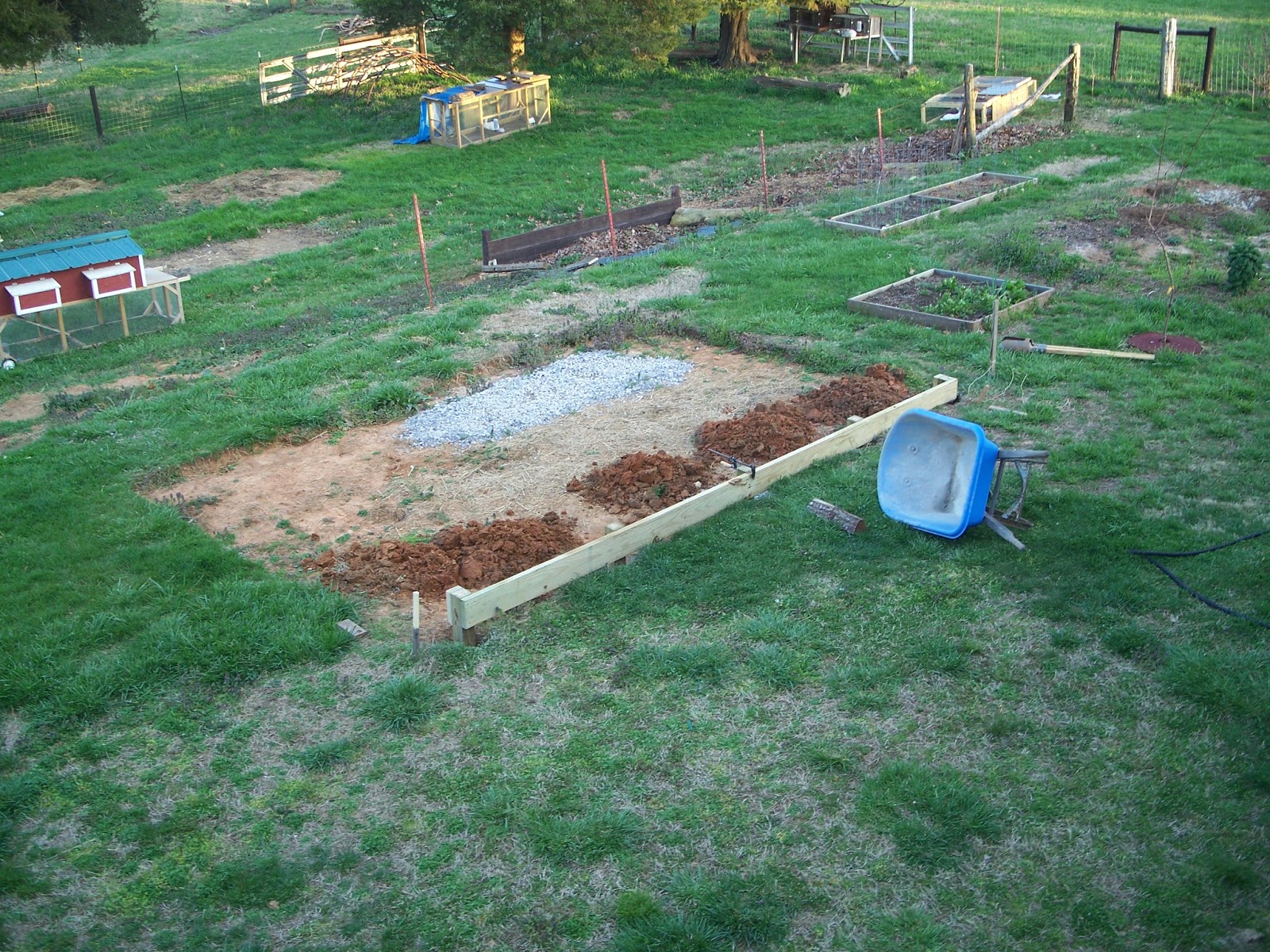
This is a picture of the greenhouse foundation getting started.......it's really going to happen!!  We have been cultivating the gardens and planting all kinds of vegetables.  Won't be long before we get our first sun-kissed vegetable.


The front is almost wrapped up and looks really nice.  You Rock Pat and Ian!!

Monday, February 11, 2013

Planting Ginger Root

We use a lot of ginger here for cooking and medicinal use so I thought it might be fun to see if we could grow our own.  I also gave some to a couple of friends to try before I found this useful information.

http://www.gardeningknowhow.com/edible/herbs/ginger/growing-ginger.htm

I will have to send them the link.  For example, I was thinking that it needed sun and read in this article how it needs shade.

If you buy ginger and leave it out on your counter it will start to sprout after a while.  Here is my ginger and the pot I am going to use to plant it in.


Ginger is used medicinally for motion sickness, nausea and vomiting.   Colds, Flu symptoms, headaches, and arthritis to name a few.  I like to grate it up in honey and make ginger-honey for teas and on toast or biscuits.
I also save and dry the peel when I use it for cooking.  The dried peel goes in my chai concentrate tea as one of the spices.  If you decide to try it give me an update in the meantime I will plant these roots and hope to give you an update in the future.

Starting seeds

 It is time to think about starting some seeds for re-planting out in the garden come warmer weather.  I try to buy heirloom seeds as much as possible and have been known to save seeds from plants that I really like.  There are a few resources for heirloom seeds via the internet.   I love the packages that I get from Baker Creek Heirloom Seeds because they are so colorful.  I have ordered from Heirloom acres, Southern Exposure Seed Exchange, Pinetree Garden Seed, and Seeds of Change in the past.  I also look for companies that provide non-GMO if possible.  It can change from year to year, you might be surprised that a company you were buying seeds from has sold out to Monsanto so be careful and do your homework before ordering if you care about such things.

For me planning the gardens and starting seedlings (as well as planting) can be stressful because there are so many decisions to make......I don't like to make decisions.  It would help if I only had two types of tomatoes to choose from or two types of cucumbers etc.  Don 't get me wrong, I love the choices provided and the variety.  It's just that I only have so much room in my gardens to plant.  If I had my way the whole yard would be a big garden, but I don't have my way and I wouldn't be able to keep up with it if it were so maybe that is for the best after all.  Everything in balance, right?  I included a picture of our dining room table with some of my seeds layed out so you can see the chaos.  The box behind the canister is full of seeds packets as well.  I have another box of "warm season" seeds like squash, bean, cukes, corn, and watermelon.

With my daughters help, I have filled the seed trays and hung my light for another year of starting seeds in the house.  You might remember the ground breaking for the greenhouse....no greenhouse yet.  So this is my set up for starting seeds.  It works and that is all that matters!!

Now I really must start deciding how much of what what I will plant.

2/12/13 update:  Between goat births and dinner at a friends house, I was able to plant cabbage, broccoli, sweet peppers, hot peppers, and some tomatoes in my pots.  Still have some pots to plant, hope to do that tomorrow.

Wednesday, January 23, 2013

Longer days and garden planning

Have I ever mentioned that I love being outside in the garden?  If I haven't, now you know.  When I die and go to heaven, I want to take care of the plants in the gardens there.  Probably won't need me since there won't be any weeds, lack of water, bugs, or diseases to deal with.  Maybe they will let me design the gardens.

Can you also tell that I am longing for warm dirt, fresh greens, and the new life of spring?  Well, that pretty much sums it up.  The problem is I have been getting seed catalogs in the mail.  How do they know the right time to send them to winter-weary people?  I know I should be thankful, I still have broccoli, cabbage, and some leaf lettuce in my raised beds but I am ready for warmer weather and digging in the earth.

To satisfy my desire for planting, I sketch garden beds, catalog my seeds, and plan where everything will be planted this year.  I start by assessing how well (or not well) everything grew the year before.  Plan on growing more of the well growing plants and exchanging the poor growing plants for another variety in hopes of finding a more vigorous producer for our area.  I keep records on what is planted where so I can rotate the crops from year to year.  Garden planning is a little like being an architect as far as I'm concerned.  I put as much time and effort into it as an architect does in his blueprints of a cathedral, maybe more.

So, enough of my silliness.  I really am doing some garden planning and looking forward to the end of February when I will start some seedlings for the garden.  An I am very thankful for the longer days we are getting, aren't you?

Wednesday, October 24, 2012

Fall and planting garlic

Fall is here and with the cooler days and nights we are feeling an urgency to get the garlic planted, the gardens beds cleared, and some of the outside projects that we have been putting off done.

I love the smells and colors of fall.  We are at peak this week in my little part of the world.  I have been driving and walking around trying to soak up the beauty around me.  I want to store it up for the long brown days of winter that lay ahead.  Don't get me wrong, winter is nice for the slower pace and time you have to reflect and plan for the next growing season.  I just have issues with less daylight hours, colder/wet weather, and the tapestry of browns that canvass the landscape in winter.  So, for now I will spend as much time as I can enjoying this season....maybe stopping the pace of life to sip a warm cup of tea and inhale the fresh, crisp air before it is too late.


We planted (Pat and the boys) 4 different kinds of garlic this year.  Pat has decided to take over the garlic raising, he has put a lot of thought and effort into it.  I am pretty proud of him and can't wait to see the finished product next summer.  We are thinking that is we have plenty, we might try to sell it from the farm or at the farmer's market next year.
The garlic came in net bags with labels.  When you plant garlic, you have to break up the heads and plant the individual cloves.  We sort the cloves and only plant the larger ones.  "Big cloves produce nice size heads of garlic", or so we are told.  In my experience it also depends on the year as far as weather, the bed they are planted in, and how they are cared for.  Garlic is one crop that is pretty easy to plant, grow, and care for.


Here is a picture of Connor planting a row of garlic.  Notice the white string that is attached to stakes that is helping him plant a straight line?  This is something I love about Pat, he is very thorough about any job he does.  Me, on the other hand would have raked up the bed and eye-balled a straight line while I was planting.  My rows aren't always too straight.  What can I say?


Here is another picture of Connor getting to clean up after me.  That was one big pile of mint and roots I pulled out of the flower bed.
I will have to see what other yard chores we need to complete before the cold weather really hits.

Wednesday, September 26, 2012

fall stuff


 We have been working on pulling the pepper and tomato plants in the garden in preparation for fall and the coming cooler months.  I re-planted some broccoli and cabbage to harvest through the fall and early winter months.  I used some crinoline that we had laying around to cover the plants.  I am hoping to keep the cabbage loopers off them.  The picture above is the lower garden  with Swiss chard coming on nice and my asparagus taking off.  I can't wait to harvest some asparagus come spring.  In the foreground is an apricot tree we planted last fall and you can see our peach tree behind the garden.  We had a couple of peaches this year but the tree didn't get enough water so the peaches shriveled up and fell off.  We have also picked most of the tomatoes from the plants and put them on our back deck to ripen.  We grew at least 4 bushels of tomatoes this year.


 This is a picture of Squeak hanging out in the asparagus.  He was jumping up in it before I took this picture and he spends a lot of time lounging around in the shady depths of the bed.
Pat and the boy's cleared a bed out front to plant the garlic in.  We ordered 5lbs this year and Pat is going to be in charge of planting and growing it.  To prepare the bed we dug it up well and added goat pellets, aragonite, and a small amount of phosphorous which we turned in to the bed.  Now all we need is the garlic.

It is getting chill here at night and we are in full swing trying to wrap up some of the fall chores before cold weather.

I leave you with this lovely picture of a pooped puppy.

Sunday, July 8, 2012

Rattlesnake Beans


A friend gave me a big paper grocery bag full of rattlesnake beans.  It seems she had plenty for her family and wanted to bless me with some of the extra.  I was so thrilled to get them.  I have never planted rattlesnake beans but know that they are a pole type bean.  They also have real good flavor.  Anyways, thank you Kim, I canned 13 quarts of beans that will taste mighty fine come fall.  Now to finagle some seeds for next years garden..........................  I will be planting more pole beans than bush beans next year since the bush beans don't produce as many beans for as long as the pole beans do.

Tuesday, May 22, 2012

First Cucumbers


We are very excited at here at the farm...........it is very close to cucumber season.  Our family can literally eat a 1/2 bushel of these yummy little guys a day at the peak of the growing season.  No matter how many we have or for how long, the kid's (or our) hunger for them does not wane.  I have considered putting an electric, kid proof fence around the cucumber patch in past years but my husband and I are as bad as the kids.  From the time someone notices that first little cucumber to the long awaited bite (since cucumbers grow so fast), all six of us tend to check on that little guy at least twice a day hoping to be the one to pick it and have it all to ourselves.  This is where character training comes in handy.  By character training I mean learning to share.  Since the kids usually beat me out to the garden, I am very glad that I taught our kids to share.  The unsaid rule has always been that we share the first cucumber of the season but the rest are up for grabs.  I must confess that there have been tussles over cucumbers if the patch isn't producing fast enough.

I planted 10 hills of cukes this spring thinking that we would have enough.  Since seeing the first little cuke last week, my husband suggested that we find another place to plant a few more cucumbers in case we run short.  Personally I think he is hoping to have his own secret patch to himself.  I know it won't work because I swear the kids can smell them, in fact I know they can since I have tried to hide a few here and there and I am always found out.  All kidding aside, we have found a couple of little guys and hope to have some cucumbers to eat maybe by next week.  Unfortunately, two of the kids are going to stay with their grandparents for a couple of weeks and may not get to help us eat the first one but I am sure that by the time they come home, there will be plenty to plunder in the garden.


Thursday, May 17, 2012

Harvesting some garlic today


I love growing and using garlic in the kitchen and for colds and flu.  Every year we plant garlic and when it is harvested I am stingy with its use.  So last fall we planted tons of it in hopes that it would get us through a year.  The problem always is to save some of the cloves back to re-plant in the fall for the following year.  That is where it gets me, there is never enough to plant "lots" for the next year.  In my opinion of course.

The garlic came so early this year because of the warm winter and spring we had.  A couple of weeks ago I started pulling the blossoms off the garlic to help it grow bigger.  The blossoms are called scape's and are good to saute and put into recipes calling for garlic or onions.  You can also make herbed vinegar with them and they look really neat in the jar.  What I don't use right away I freeze for when I might need some for cooking.  They are especially good in greens like Swiss chard and spinach this time of year.


Once you pick the scape's off, you have to wait until the whole plant becomes 1/2 to 3/4 brown.  Then it is time to dig them up and place them in bundles to cure.  Curing is basically letting the skin on them dry out before bringing them into the house.
We bundled this garlic into ten heads per bundle and tied it with twine.  Once bundled it need to be hung in a place with good air flow and preferably no sun.  We hung ours in the rafters of our lower porch.  In a couple of weeks it should be ready to bring in.  If you plant soft neck garlic you can make a garlic braid instead of putting it into the bundles like we do.